









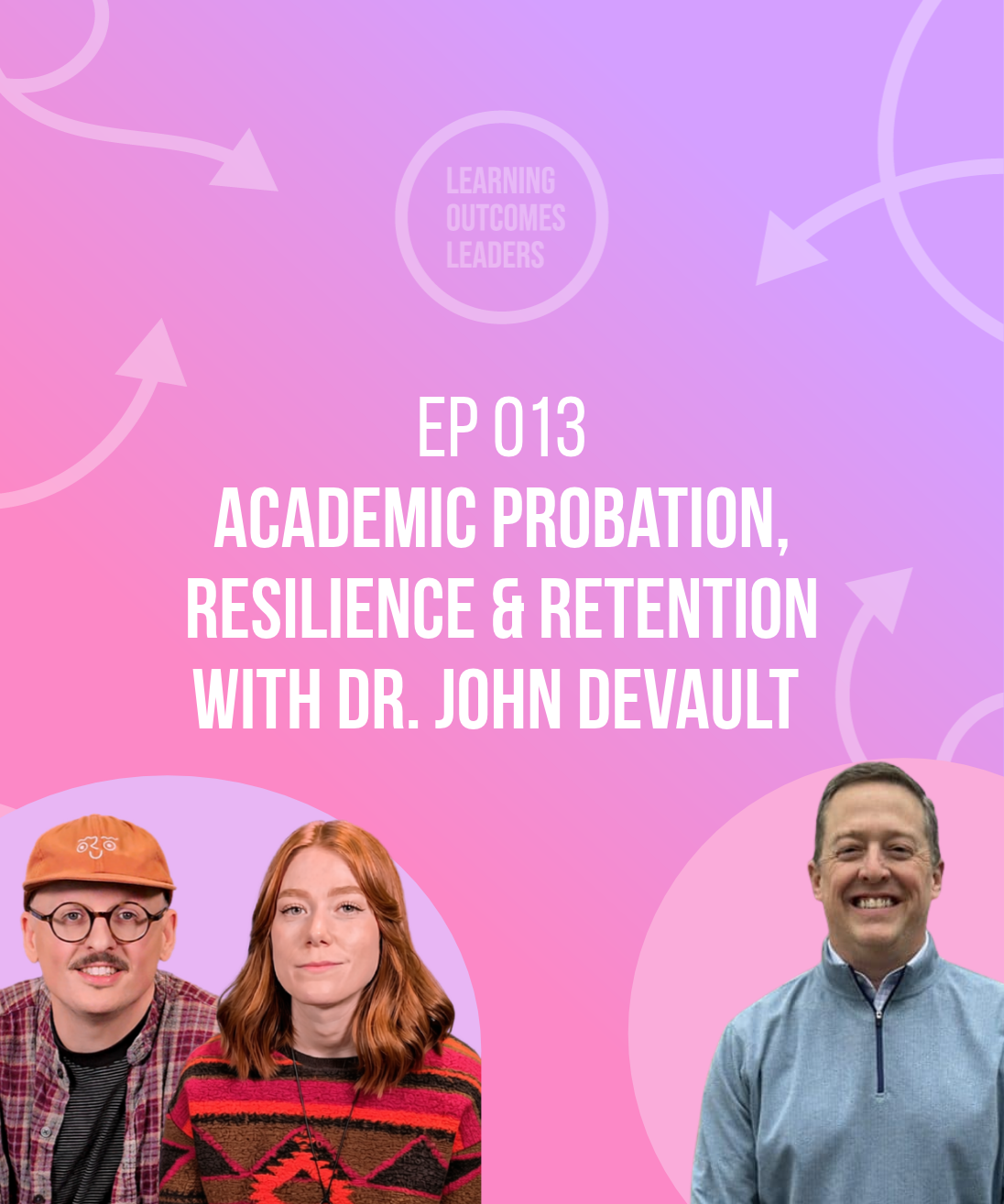
Welcome to Learning Outcomes Leaders episode 013, brought to you by Genio.
Welcome to Learning Outcomes Leaders episode 013, brought to you by Genio.
In this episode, we’re joined by Dr. John DeVault, Associate Vice President of Student Success at Ferrum College, to discuss how flunking out of college as a freshman shaped the way he supports students on academic probation.
Drawing on his experience building the STAR (Students Taking Academic Responsibility) program across two institutions, we explore why struggling students rarely ask for help. We also delve into how stoic principles like resilience and focusing on what you can control help students take ownership of their goals, and what it took to raise GPAs for 71% of the program’s first cohort while lifting fall retention from 37% to 60%.
Want to find out more? Let’s get into the episode.
Key takeaways:
- Students on academic probation rarely ask for help, so effective support is required rather than optional.
- Many academic problems are not academic. Fear of failure, work ethic, and life pressures often sit underneath a falling GPA.
- In the STAR program’s first cohort, 71% of students raised their GPA, and fall retention rose from 37% to 60%.
- Students engage more when they set their own goals. Only one of 134 students chose to leave when given the option.
- A student success program can launch without new budget by reallocating existing resources.
Questions answered in this episode:
What is the STAR program for students on academic probation?
STAR (Students Taking Academic Responsibility) is a required support program that combines a class built on stoic principles with student success coaching and tutoring.
Why don’t struggling college students ask for help?
Struggling students often avoid asking for help because admitting there’s a problem feels riskier than hoping it goes away. As John puts it, failing without trying can feel safer than trying hard and still failing.
Does academic probation support improve retention?
Yes. At Ferrum College, 60% of STAR students returned the following fall, compared with a historical rate of 37%. When the program grew to 134 students, 66.4% raised their GPA.
Should academic probation support be mandatory?
In John’s experience, yes. Students on probation rarely seek help on their own, so support needs to be part of their plan for returning.
How can colleges start a student success program with no budget?
Start by understanding what your students need, shift existing resources to meet those needs, and use early results to win support from leadership.
Subscribe to Learning Outcomes Leaders wherever you listen to your podcasts


Share this blog




Time for a simpler, smarter note taking accommodation?