


















Compliance is currently top of the agenda for higher education institutions across the US.
Following new legislation, published by the U.S. Department of Justice under Title II of the Americans with Disabilities Act (ADA), colleges and universities will be required to make sure all their webpages, online course content and mobile apps are accessible to people with disabilities.
Commonly understood through the lens of the Web Content Accessibility Guidelines (WCAG) 2.1, Level AA, from April 26th 2027 adherence will be mandatory, with third party technologies also required to meet the criteria.
Genio’s approach to accessibility
At Genio, accessibility is part of our DNA. Since 2007, we have created accessible technologies that have positively impacted over 160,000 students across 1000+ institutions. Our core philosophy is to combine accessible design with learning science to create tools that address the fundamental challenges preventing learners from thriving in education.
We care deeply about accessibility and invest heavily in it, ensuring that we will meet all WCAG guidelines ahead of April 2027. In doing so, we strive for our future vision of a world where every person has the tools and confidence to expand what’s possible through learning.
As part of this, we regularly complete ACR (VPAT) testing, via third parties, to hold ourselves to account and ensure our product development has accessibility baked in, rather than bolted on.
This point is particularly important as accessibility overlays only provide surface-level visual fixes, failing to address underlying source code issues. This can cause additional issues with existing assistive technology, poor user experience and a false sense of legal security and compliance.
What is an ACR (VPAT) and why do they matter?
An ACR (VPAT) is a standardized template developed by the Information Technology Industry Council (ITI). It is used by various technology vendors to document how well their products or services, including software, hardware, or electronic documents, conform to specific accessibility standards.
By its very nature, software development is an iterative process. This means as new functionality is introduced, or systems are updated, there is a chance that new bugs make their way into the technology.
ACRs (VPAT), and remediation plans, are an invaluable way to track these bugs, as well as document how they have been rectified to ensure a technology remains as accessible as possible, at all times.
It is an equally critical tool for organizations, in this case higher education institutions, when they are purchasing new technology. It allows them to quickly and credibly compare and assess the accessibility of different vendor products, providing them with a clear, structured, and transparent overview of a product's accessibility features and limitations.
Third party verification
It is critical that vendors use a professional third party consultant when completing their ACR (VPAT); as opposed to AI scanners or doing it themselves. Third-party validation ensures objectivity and trust, demonstrating due diligence.
Professional firms also offer deep, specialized WCAG expertise that internal teams often lack. They perform comprehensive manual testing and use multiple assistive technologies, which automated scans miss.
Their reports provide detailed, accurate technical evidence and actionable remediation guidance, ensuring a correct interpretation of success criteria. At Genio, we have worked with Level Access for a number of years to ensure our own compliance.
Genio’s VPAT and remediation plan
Given the impending April 2027 deadline for WCAG 2.1, Level AA, Genio have taken a proactive approach to improve our already robust standing and guarantee accessibility for all learners. As well as compliance with WCAG 2.1 AA, by April 2027 we will be taking things one step further by also achieving conformance with WCAG 2.2 AA.
As well as maintaining a team of internal accessibility experts, we are constantly striving to improve our understanding of, and skillset around, accessibility. This December, our entire Engineering function is using one of their hack weeks, a week where they collaborate, innovate and experiment on different themes, to focus solely on upskilling and sharing tips and tricks on accessible development.
To view our remediation plan, and read more about our work, click here.
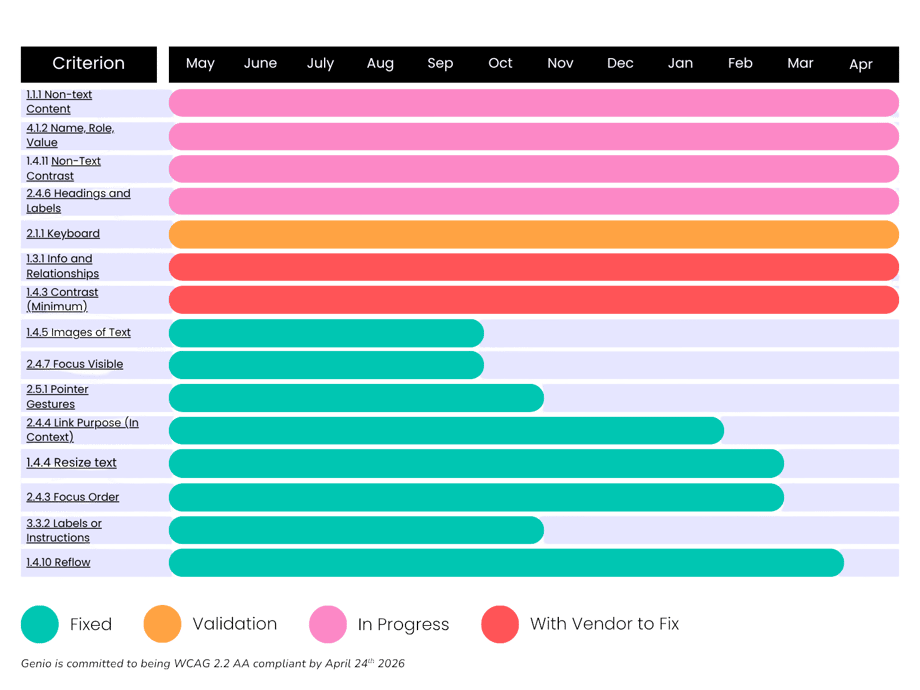
Image accurate as of April 2nd 2026 - check our remediation page for the most up to date insights.
What questions should you ask your vendors?
Even if you aren't a Genio customer, we want to make sure you're using the right software for your institution and students.
It is crucial that you do not take vague claims of compliance at face value, and do a little digging under the surface to truly understand the validity of any test.
To help with your decision, it’s important that you’re equipped with the right questions to ask your vendors, to ensure both you and they are meeting compliance guidelines and, most importantly, providing truly accessible solutions.
Key questions to ask include:
- How does the vendor maintain WCAG compliance and what testing is in place for new features?
- How does the vendor deal with accessibility bugs in product development?
- Does the vendor provide appropriate ACR (VPAT) documentation?
- Is accessibility testing performed manually, or using automation? Is a third party used for objective testing?
- Does the vendor's software rely on an accessibility overlay/widget?
To find the answers you should and shouldn't look for, read our full vendor questions document here.
At Genio, our products follow our core principles: beautifully simple, meaningfully structured, and effortlessly connected. They are accessible by design and exist to scaffold the learning process.
As the deadline for WCAG 2.1, Level AA draws near, we’re taking the necessary steps to meet compliance guidelines and retain the highest levels of accessibility. It’s in your hands to make sure your other vendors are doing the same.
Share this blog





Time for a simpler, smarter note taking accommodation?