

















Exams are coming up, you know you need to start studying, so you reach for your pack of flash cards and start writing out all the key concepts and ideas you need to know…
It’s the same study method you’ve used since high school - your teachers always suggested it, all your friends use them and they always come up as one of the best ways to memorize content.
But every time you use them you’re hit with that same feeling of little progress and not genuinely knowing the things you need to know. How can such a highly recommended study method feel like so much work for so little pay off? 😔
Flashcards really are one of the most versatile and effective study methods, but only when used correctly, that means actively testing yourself not just re-reading.
Let’s make this year the year your flashcards finally start paying off for you, because when you feel them working you won’t want to use another study method!
👀TL;DR? Watch the TikTok here! Why your flashcards aren’t working
Most of us are never taught how to properly make and use flashcards - you’re introduced to them in high school but teachers are busy, they don’t always have the time to explain how to make them.
So, you pick up a card and write what you need to know on it - that seems like how they’d work, right? Unfortunately, it’s not 🫣.
Here’s some of the most common mistakes students make when creating and using flashcards.
1. Only using 1 side
Flash cards shouldn’t look like cue cards. Having a card with a title and lots of information to read is just not it. Simply reading or re-reading is ineffective; it’s a passive method that often leads to recognising information, but not recalling it.
2. Writing too much information
Avoid copying out large chunks of the textbook or excessive detail, as this makes cards overwhelming and less effective. Again, they shouldn’t look like a prompt or cue card!
3. Not reviewing them regularly
Grabbing your cards to re-read the day before an exam won’t help you learn the content. Sure, you might remember a couple of points, but you’re not able to recall the details that will allow you to answer difficult questions.
The science behind effective flashcards
Before we get into how to make flashcards that work, it's important to understand how flashcards work. For a flashcard to be effective it relies on two things: Active recall and spaced repetition. These are two fancy learning science terms but they’re really important.
Active recall: Flashcards force the brain to search for information, strengthening the neural connections to memories. Essentially, it’s testing yourself to remember something.
Spaced repetition: To remember something long term you need to move it from your short to long term memory, combating what we call the "curve of forgetting”. Combining flashcards with spaced repetition dramatically boosts retention of knowledge as you gradually increase the time spent in between using them.
How to create flashcards that actually work
So we know flashcards should test us and be used regularly, but what does that actually look like? 👀
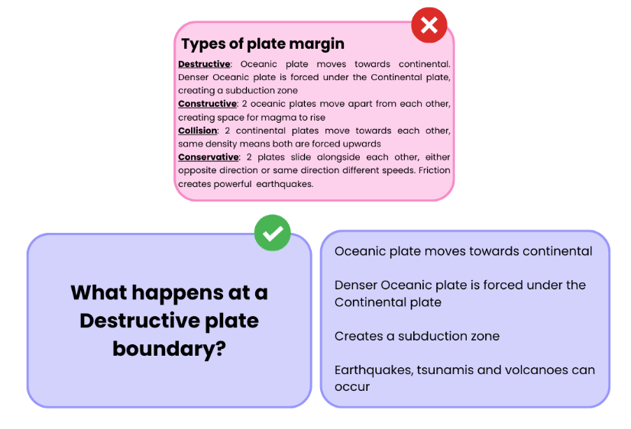
Flash cards done properly should actually be a lot less time consuming to make, as they don’t have tonnes of information or paragraphs written out on them. Here’s three tips to making flashcards that will genuinely work and a diagram to show you how they should look.
1. Make them double sided
There’s lines on both sides of the flashcard for a reason! Make your flashcards doubled sided by having a question on one side and answer on the other.
This means they can actually be used both ways around - if you pick up the answer side try to recall what the question would be.
2. Keep them short and simple
Each card should contain a single idea or concept. If an idea is complicated, break it down into multiple flashcards to tackle single points.
- Example: Date on one side, event on the other.
- Example: Diagram (unlabelled) on one side, labelled concept on the other
3. Use active questions, not terms
While it is integral to know definitions, make sure lots of cards also have focused what/why/how questions, so you can learn key concepts and theory as well as facts or definitions.
- Example: Why is HDI an effective measurement of development?
- Example: What is the difference between quantitative and qualitative data?
- Example: How can infection spread?
Here's an example of how your flashcards should, and shouldn't look, using the checklist:
- Double sided ✅
- Start with a question ✅
- Short and simple ✅
How to study from flashcards
Once you’ve made flashcards that test your recall, you can use them in a few different ways to keep your study time engaging and moderately difficult.
📥The Leitner System
This is when you sort cards into difficulty-based 'boxes' or piles, moving correct answers up and incorrect ones back to the start, ensuring more frequent review of weak areas. During the weeks before an exam you want to have three piles:
- Cards you know really well
- Cards you sometimes answer correctly
- Cards you consistently can’t remember.
Focus on those weaker areas the most, ideally daily, aiming to move them into the middle pile. The ones you know well still need to be checked in on, but you can increase the time spent ‘forgetting’ them to really solidify your understanding.
🤔 Explain and elaborate
Once you recall the basic answer, push further by asking "why" and explaining the topic in detail, consolidating your understanding.
Example: Your card says ‘How can infection spread?’. Once you answer correctly you could think about elaborating on ‘What interventions have been developed to prevent infections spreading?’ or ‘Can I name 3 examples of infections?’.
🪢Interleaving (mixing topics)
Change the order in which you study related card sets or topics to force your brain to switch between ideas, which improves memory. It’s important not to stick to the same order constantly as we start to remember patterns rather than the actual content itself, so mix it up a bit!
Are digital flashcards better than physical?
With the range of apps now available, many students choose to have digital flashcards rather than physical.
There are some really powerful apps to help with flashcards, such as Quizlet or Anki. They can make studying much easier, you can literally study anywhere as long as you have your phone and they often have algorithms to help with repetition. But, many of us just prefer writing them out by hand, and that’s fine too!
The best type of flashcard is the one you will use consistently.
Studying effectively is a skill, it takes a lot more practice than we often think, but once you find a method that really works for you, it should feel like things click into place and you find your flow 🤩
Need more study tips? Check out our student resources or more study tips below!
Share this blog





Time for a simpler, smarter note taking accommodation?