





Summary:

  • New Majority Learners are here to stay; with notable 20.9% and 8.9% increases for disabled students and learners over the age of 22.
  • New Majority Learners fall into 3 main categories; time poor, underprepared, and facing individual barriers.
  • AI, in the case of New Majority Learners, is not necessarily acting as an equalizer, but instead widening existing achievement gaps by denying the opportunity to encode material that is crucial for achieving mastery.
  • An independent study, conducted by LXD Research, of over 2000 students described Genio Notes as essential infrastructure for managing academic demands; particularly those balancing multiple responsibilities or managing learning differences.
  • Using Genio Notes, New Majority Learners successfully maintained a higher baseline GPA, reported lower stress levels than peers and overindexed on confidence growth by 17.2 percentage points.

Non-traditional learners, sometimes known as ANDers, make up the majority of the student population across higher education.

Over 40% of students are over the age of 22 and almost 70% work while studying. Around 30% of learners are first generation, while just shy of 20% have English as an additional language.

And whether they fall into the category of being time poor, underprepared or facing individual barriers, institutions must adapt and evolve in order to support their needs, and facilitate their success.

In this report, Genio will lay out the characteristics that make up these student demographics, explore how AI could become more of a hindrance than a help for them and evaluate exactly how tools like Genio Notes can underpin New Majority Learner success.

Negative learning experiences can result in self-blame, frustration, and reduced academic self-efficacy, creating a downward spiral that impacts individuals, institutions and society at large. Yet all of these outcomes are avoidable.

By understanding and embracing the needs of the New Majority Learner, institutions can provide the tools and support for learners to take control of their learning thereby increasing retention rates, improving the student experience and ensuring their own sustainability; all while contributing to a more prosperous future for each and every learner.

"Higher education is navigating a significant demographic evolution. The once predominant traditional student is now part of a broader, more complex picture known as the New Majority Learner.

These learners are not less capable. They face genuine structural barriers to learning which have nothing to do with aptitude and everything to do with the environment.

For institutions committed to meaningful reform and fostering student success, understanding and proactively supporting this group is a fundamental imperative. Through prevention over cure, learner-centric reform is driven by empowering students to engage more deeply and effectively with their education.

By understanding the New Majority Learner, and strategically investing in tailored technological tools and skills development, colleges can significantly improve student outcomes, thereby truly fulfilling their mission to ensure every student succeeds."

Dave Tucker, Genio Founder & CEO


Dave Tucker profile

Who are New Majority Learners?

As the trend continues of non-traditional learners forming the majority across the United States, it is vital for educators to understand both their characteristic nuances and their shared experiences.

Learning remains an inherently personal journey, the success of which requires proactive participation in a system that works for each learner as an individual. Those working in higher education have it within their power to facilitate this, and make the necessary changes to avoid a cycle of disengagement across their cohort.

By way of reintroducing the New Majority Learner, below you will find three overarching categories into which these non-traditional learners fit. These groups are based on traits that often align with one another to form the lived experience, and shared challenges, of these learners.


Christine Paige, Palomar College

The time poor learner

"I'm a single parent, I also work and volunteer. Without Genio Notes I don't think I would be able to have the grades that I have now."

Christine Paige, Palomar College

Demographics

  • Working
  • Part-time
  • Parents
  • Economic hardship

Challenges

  • Unable to devote enough time to studying due to other responsibilities
  • Worrying about finances leading to distraction from studies
  • Being distracted by children or other dependents

Goals

Balance their time effectively so they can succeed in their studies whilst maintaining other responsibilities.

Audreu Dennis, University of Alberta Campus Saint Jean

The underprepared learner

"I am a first-year university student and Genio Notes has completely revolutionized my way of studying. Having this tool that I can use to improve myself and to improve the way I study has been extremely beneficial."

Audreu Dennis, University of Alberta Campus Saint Jean

Demographics

  • First-years
  • Age 22 plus
  • First Generation
  • Transfer-in
  • Veteran

Challenges

  • Lacking the necessary study skills to succeed in higher education
  • Feeling disadvantaged compared to peers
  • Lacking confidence in academic settings

Goals

Successfully integrate into higher education study and achieve their potential.

Ricardo Meija, Virginia Peninsula Community College

The learner with individual barriers

"And as an individual with high functioning autism, Genio Notes helps me retain the information better and has reduced my stress."

Ricardo Meija, Virginia Peninsula Community College

Demographics

  • Ethnicity
  • Immigrants
  • English as an additional language (ESL)
  • Neurodivergent
  • Disability

Challenges

  • Issues with concentration, attention and cognitive overload
  • Experiencing stigma
  • Lack of confidence
  • Feeling stressed about studying

Goals

Study like their peers without barriers, without standing out, and achieve their potential despite barriers.

The New Majority in higher education

As with any cohort, the dynamics and demographics are constantly shifting. Using the most recent IPEDS data, we have researched how the New Majority Learner population continues to evolve, with a particular focus on how that manifests across Carnegie classification.

Evidently, non-traditional learners do indeed constitute the majority population in higher education. Going a step further, and breaking this data down by Carnegie classification, a picture begins to emerge of how the nuances of New Majority Learners cohorts manifest across different institutions.

For learners over the age of 22, baccalaureate colleges-general have seen the biggest relative increase at 3.5% while associate’s colleges have experienced the greatest shift in transfers at plus 9.5%.

In a similar fashion, veterans have seen the largest increase at baccalaureate/associate's colleges at 2.2% whereas for those learners with disabilities, doctoral/research universities-intensive have undergone the biggest increase at plus 7.0%.

Characteristic 2025 data 2026 data
The time poor learner
Working69.3%N/A*
Part-time39.2%39.6%
Parents19.2%N/A*
Economic Hardship16.9%N/A*
The underprepared learner
Age 22 plus40.2%43.8%
First Generation29.6%N/A*
Transfer-in6.4%6.1%
Veteran3.3%2.6%
The learner with individual barriers
Ethnicity32.7%33.5%
Immigrants25.0%N/A*
English as an additional language (ESL)17.7%N/A*
Neurodivergent16.5%N/A*
Disability4.3%5.2%

* 2026 data was not available for some characteristics owing to the publishing cycles of the IPEDS and NPSAS studies. For more information, see the Methodology section of the report.

So what does this mean for institutions?

Put simply, what worked before, won’t necessarily work now. While each of these identifying characteristics can identify an individual as a New Majority Learner, it is critical to also note the regularity of intersectionality of these traits.

For many, their identity extends beyond one individual characteristic adding complexity, and nuance, to the opportunities for higher education leaders to better equip, empower and encourage their student cohort.

Consider the working population… these students are time poor, and likely find themselves trying to absorb their course material in a range of environments such as a break room at their place of work or during their commute.

Or the overreliance of first generation students on financial aid and added difficulty of being an ESL learner whose insufficient support services lead to a lack of persistence as the obstacles to learning simply become too substantial to overcome.

Each learner faces unique challenges and opportunities in the higher education journey, the reality for New Majority Learners is that, without an evolution in support mechanisms, these barriers risk becoming insurmountable.

"For many students, AI has become a vital assistive technology through real-time transcription or reading assistance. However, there is a fine line between a tool that assists and a tool that replaces the student's own thinking."

Keely Reeves, Student Development Specialist from University of Arkansas at Little Rock

The impact of AI on the New Majority Learner

Armed with the knowledge of the demographic makeup of both New Majority Learners and the wider student cohort as a whole, institutions can begin to make adjustments and adaptations to promote academic self-efficacy and ensure their long term success.

One common avenue of approaching this is through technology, and specifically, AI. There is no doubt of the potential of AI for empowering New Majority Learners, yet, alongside the potential issues around exacerbating the digital divide, there is a real risk of overcompensating. This can lead to a loss of the appropriate level of productive friction, the cognitive effort required for deep learning and long-term retention, where technology becomes more of a hindrance than a help.

"Access without autonomy is not access."

Lauren Tenney, Disability Rights Advocate

The lure of offloading

A review of the literature emphasizes the lure of cognitive offloading to reduce productive friction, particularly among those students who are time poor, navigating college without familial knowledge or support and financially struggling.

However, studies into cognitive offloading show that while immediate recall is improved, it comes with significant pedagogical debt in long-term memory. This reduced participation could lessen the productive friction necessary for critical encoding and deep learning, being further disadvantageous to those who most need proactive participation.

While this paradox affects all learners, it is particularly damaging for the New Majority Learner. For these students, frictionless AI is not acting as an equalizer but is instead widening existing achievement gaps by denying them the opportunity to encode material that is crucial for achieving mastery.

Considering again the example of the time poor working parent, it becomes critical that institutions move beyond frictionless shortcuts and instead provide the active scaffolding required for students to become the architects of their own learning.

While AI is frequently positioned as a tool for equity, and can afford New Majority Learners some benefit, it can in fact widen existing gaps. To protect the New Majority Learner and prevent them from passively inheriting systemic biases and linguistic prejudices embedded in AI outputs, educators must avoid a "frictionless" experience.

So while the promise of frictionless automation offers an attractive solution to the time poverty and mechanical burdens faced by many students, institutional leaders must recognize it for what it truly is, a deceptive shortcut that trades long-term capability for short-term efficiency.

Only once this acknowledgement has been made can institutions truly learn how to leverage AI to their students’ benefit.

How to use Genio to support your New Majority Learners

Now that institutions understand who the New Majority Learner is, how the data has shifted, and the potential ramifications of AI overreliance, leaders can explore exactly how non-traditional learners can be best supported.

At the centre of all such discussions must be the students themselves. This is the integral alignment between appreciating that learning is a personal journey and isn’t just about teaching, but equipping, encouraging and empowering learners to actively engage with information.

In our 2025 New Majority Learner report, we discussed a number of ways in which to support New Majority Learners. Underpinning a large proportion of these initiatives is technology. Technology like Genio.

New Majority Learner Report 2025 illustration

At Genio we’re constantly looking for better, faster, and more innovative ways to empower learners who are prevented from achieving more. Our roots in assistive technology run deep, and the true equity that smart yet simple EdTech can achieve for those facing barriers in their learning remains at the core of our mission.

We also know how important it is for educators to be able to rely on, and trust in, the technology they’re using as part of the learning process which is why we verify our impact independently, to clearly demonstrate our commitment to ensuring each and every learner has equal access to education.
We verify our impact independently

The impact of Genio on student success and retention in higher education

This study captured data from over 2000 learners, and investigated multiple dimensions of student success to demonstrate the importance of evidence backed technologies.

Students consistently described Genio Notes as essential infrastructure for managing academic demands; particularly those balancing multiple responsibilities or managing learning differences.

Responses also suggested that reduced stress and improved note taking capabilities served as mechanisms through which the platform influenced broader academic outcomes such as retention and engagement.


"The particularly strong benefits for New Majority Learners suggest that the Genio Notes platform addresses systemic barriers to academic success
that traditional support services may not adequately address."

Schechter, R., Chase, P., & Ackerman, C. (2025)
 

Read the research Read the research
ESSA Promising 800x800

Case study: Volunteer State Community College

  • Volunteer State Community College saw an 11% increase in retention

  • Students utilizing Genio achieved an 88% retention rate from Fall to Spring, compared to 77% for students who didn’t use Genio.

  • Genio saved 28 students from dropping out

  • 88% experienced less stress because of Genio

  • 88% believed Genio has improved their study skills


"After more than 30 years in higher education, I can confidently say Genio is one of the best tools we’ve come across. I love seeing how it helps our students stay organized, learn more effectively, and ultimately do better in their classes. It’s simple, intuitive, and really makes a difference."

Anne-Marie McKee, Assistant Vice President for the Division of Student Services, Volunteer State Community College

 

Vol State logo

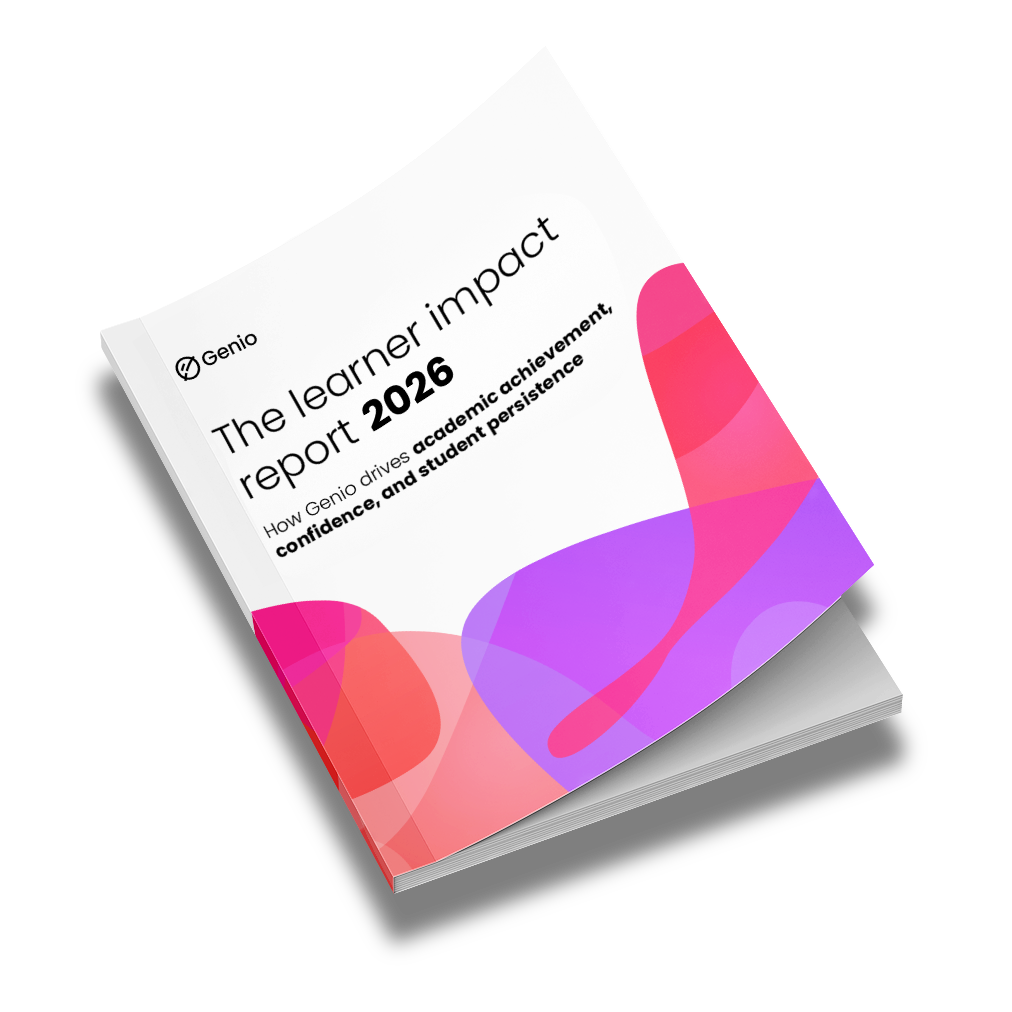
Learner Impact Report 2026

Genio surveyed over 1000 students across the 2025-26 academic year, with findings uncovering significant increases in GPA, confidence and stress reduction.

  • 82% of students feel more confident, with new learners reporting an 11.9% improvement from Fall to Spring.

  • Students saw an average GPA improvement of 3.0% over the semester, with 4.1% for new learners.

  • Students' self-reported stress scores had dropped by 11.9% on average compared to where they started.

  • For New Majority learners, parents and first years saw their GPA rise by an average of 7.6% and 7.3% respectively. Students with a disability who aren't currently receiving formal accommodations saw a 17% increase over the semester.

  • At Risk students, those starting the semester with a GPA below 2.0, saw an improvement of +1.35 GPA, a 93.5% increase.

  • 75.7% of first-generation students say Genio Notes helped them stay in school.
Read the full report Read the full report
Genio learner impact report 2026 mockup

How to support New Majority Learners throughout higher education with Genio Notes

  • We researched over 300 users to analyze how Genio Notes was impacting their education.

  • Using Genio Notes, New Majority Learners successfully maintained a higher baseline (+0.15 increase, 3.46 GPA average).

  • Genio Notes lowers stress levels for all, with New Majority Learners seeing particular benefit, reporting lower average stress (4.10) than traditional peers (4.34) over 3 years.

  • With Genio Notes, New Majority Learners overindex on confidence growth by 17.2 percentage points.


"I feel more confident in my classes. Genio has honestly made learning more manageable and less stressful for me."

Arturo Mendoza, Richard Daley Community

How to support New Majority Learners throughout higher education with Genio Notes

The challenges and opportunities for note taking in the classroom with Genio Notes

The study (over 1,000 users) found that Genio Notes positively affects note taking in the classroom, particularly among New Majority Learners.

Parent students demonstrated the highest satisfaction rate (85.6%) followed by mature students (78.8%) and working students (78.1%) showcasing how those
learners that can be categorized as time poor see significant opportunities through technology.

  • Reliable lecture capture empowers students to engage more deeply with material in real time.

  • Genio Notes users cite reduced stress and cognitive load (4.13/5) and improved study confidence and skills (4.26/5) as key drivers of their usage.

  • 84.6% of students take notes to revisit and study from them, not just to capture what was said. They aren’t offloading, they’re intentionally engaging.

Read the full report Read the full report
The challenges and opportunities for note taking in the classroom with Genio Notes

What should institutions do now?

So how can higher education leaders support their New Majority Learners? What points of connection can be altered or introduced? Where can institutions implement services at scale to match the rising demand?


Here are 3 practical recommendations that you can bring to your college, to either get the ball rolling or supercharge your efforts to support your New Majority Learners.

Equip students with technology to amplify your impact

Equip students with technology to amplify your impact

Evidence based, research backed tools like Genio Notes have been proven to increase confidence, reduce stress and improve academic performance. Leaders that proactively provide the tools needed to succeed will significantly improve the lives of their New Majority Learners both inside and outside the classroom.

Empower learners with considered AI

Empower learners with considered AI

92% of undergraduates are already using AI tools, yet only 36% are receiving support to develop AI skills. AI tools should always help to scaffold the learning process for students, facilitating proactive participation, while maintaining the right level of productive friction. Institutions that find this balance will enable their New Majority Learners to overcome their challenges, while retaining the opportunity to learn and grow.

Encourage evolution in your student support systems

Encourage evolution in your student support systems

What worked before won’t necessarily work again. Evolving student support systems, and expanding opportunities to access them, will enable institutions to improve all manner of New Majority Learner outcomes; from increased retention and overall academic achievement, to student wellbeing and academic self-efficacy.

Conclusion

The higher education landscape has reached a permanent inflection point. With a 20.9% increase in students with disabilities and an 8.9% rise in learners over age 22, the New Majority Learner is no longer a peripheral demographic, they are the core of the modern institution.

As this report has illustrated, these learners face a unique triad of pressures: they are time-poor, academically underprepared, and burdened by individual barriers to traditional learning.

And while AI is often touted as a democratic equalizer, the research suggests a more complex, nuanced reality for this cohort.

Without the right framework, AI can inadvertently widen the achievement gap. By automating the cognitive heavy lifting, generic AI tools can deprive New Majority Learners of the essential encoding process required to move from basic comprehension to true subject matter mastery.

The solution lies in proactive participation and productive friction. Across multiple studies it is clear to see that Genio Notes can provide the scaffolding necessary to augment, rather than replace, the learning experience for students managing intense academic demands alongside complex personal lives.

As we look toward the future of education, the goal for institutional leaders is clear; to provide tools that don’t just do the work for the student, but empower the student to do the work better.

Genio Notes is the cornerstone of that mission, ensuring that the New Majority Learner doesn't just persist, but thrives.

Genio illustrations_admin insights

Find out how Genio can help students in your institution

The evidence is clear.

Genio Notes is positively impacting learner outcomes across student confidence, academic performance, learner stress, persistence, retention and fundamental learning skills.

Methodology

Since the inaugural New Majority Learner report, our goal has been to provide the most accurate possible map of the shifting higher education landscape.

This year, we have refined our calculation logic to provide a more nuanced view of institutional change.

While we continue to align our definitions with the Education Design Lab framework, we have transitioned from the correlation-based estimations used in previous years to a more direct, institutional-level analysis. This shift allows for greater transparency and more actionable benchmarking for individual organizations.

Data sources and attribute definitions

The findings in this report are primarily derived from the Integrated Postsecondary Education Data System (IPEDS). All data is analyzed at the institution level to capture the diversity of the New Majority Learner student body.

Population-level calculations (the aggregate view)

To understand the New Majority Learner at scale, our annual percentage values utilize a weighted aggregate method. We sum the total number of students meeting a specific attribute across all participating institutions and divide by the total student population.

  • Year-over-year (YoY) growth: Relative change is calculated by dividing the percentage point difference between years by the baseline year's value.
  • The disability attribute: In line with our conservative reporting standards, we acknowledge that IPEDS disability data applies specifically to undergraduates. Rather than extrapolating these figures to postgraduates, we divide the undergraduate disability count by the total student enrollment. This ensures we do not overstate prevalence where data is not explicitly provided.
  • Handling data suppression: Where IPEDS does not disclose exact percentages, they aren’t reported or aren’t applicable (typically institutions with a prevalence below 3%), we have applied a conservative estimate of 2% to ensure these institutions remain represented in our averages without compromising data integrity.

Institutional trend analysis (the mean-based view)

In addition to aggregate totals, this year’s report introduces a mean-based approach to analyze institutional trends. This method treats each institution with equal weight, regardless of enrollment size, to identify the "typical" experience of a higher education provider.

Unlike the weighted aggregate totals, these figures are derived by calculating the percentage change for each individual institution first and then taking the mean of those percentages.

This dual-lens approach, comparing the "total student view" with the "average institutional view", provides a more comprehensive understanding of how the New Majority Learner population is growing across the sector.