

















Key takeaways:
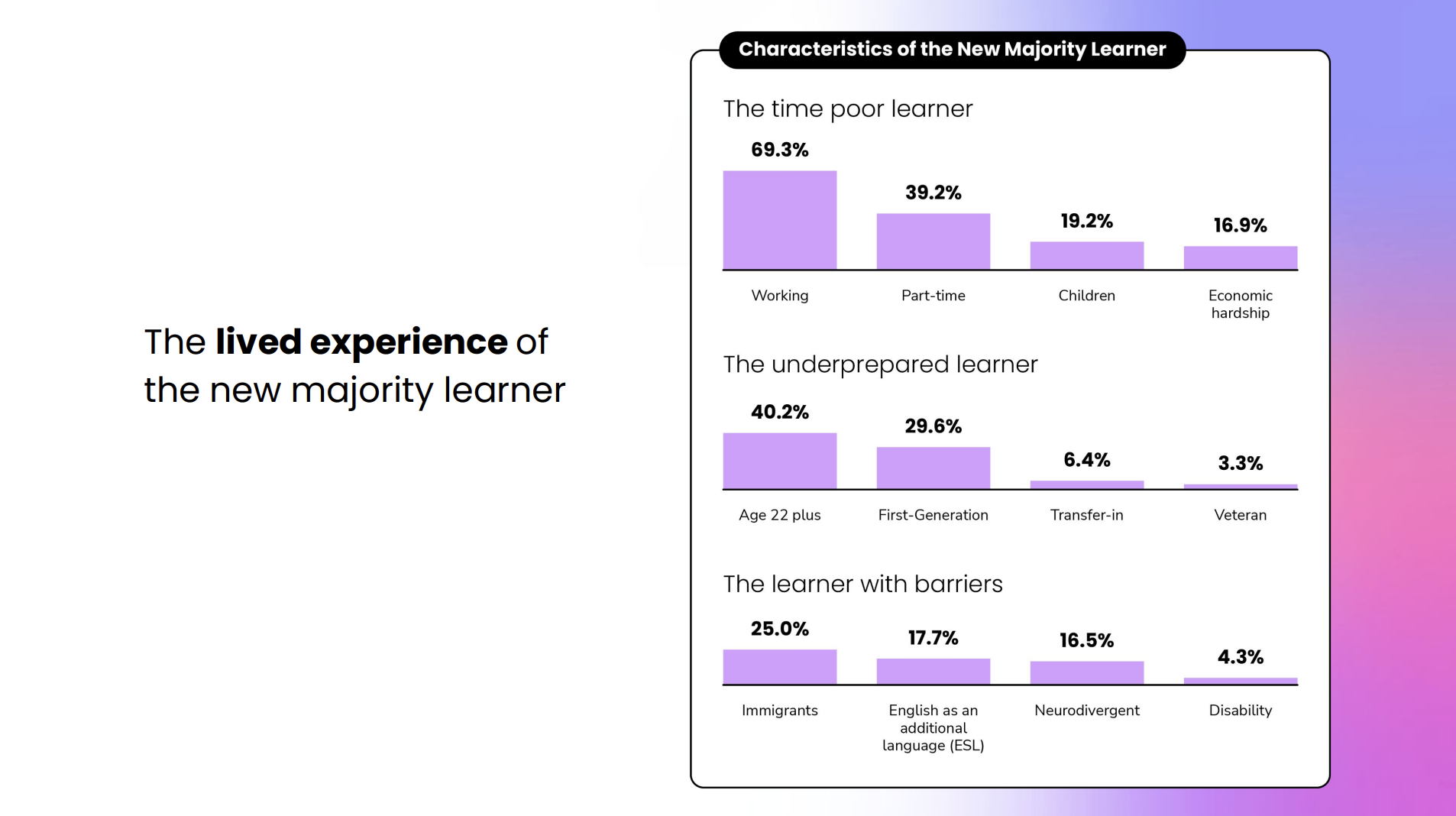
- The shift in learner demographics: Higher education is now shaped by non-traditional students who are older, working, first-generation, and managing multiple responsibilities while studying.
- Redefining student success: Student success departments are expanding their view beyond retention metrics to include thriving, wellbeing, belonging, and long-term career readiness.
- Proactive intervention: Early, data-informed support models are essential for identifying risk and addressing student challenges before they escalate.
- Inclusive technology: Accessible design and responsibly used educational technology are key to enabling independent, equitable, and effective learning experiences.
The traditional image of a college student, a recent high school graduate living on campus and studying full-time is no longer the reality. Today’s New Majority Learners are returning to education later in life, navigating financial pressures, or entering higher education without prior exposure to independent learning environments.
To ensure these students don't just enroll but actually thrive, higher education must shift from reactive crisis management to proactive, prevention-first support.
In a recent webinar hosted by Times Higher Education and Genio, CEO Dave Tucker joined a panel of distinguished experts to discuss this shift: Michelle Shaw, Director for Student Accessibility Services at Florida Atlantic University, Tammy Wyatt, Senior Vice Provost for Student Success at the University of Texas at San Antonio and Glenn Davis, Vice President for Student Engagement and Success at Bowling Green State University.
Together, they explored how universities must rethink traditional support practices to offer more inclusive, proactive and all-round assistance to students.
What are the key barriers to student success today?
New Majority Learners often face multiple issues including financial hardship, work-life balance and language barriers. New challenges like digital fatigue and a post-pandemic decline in academic confidence have emerged, creating a complex needs profile that can be often overlooked when providing standard avenues of support.
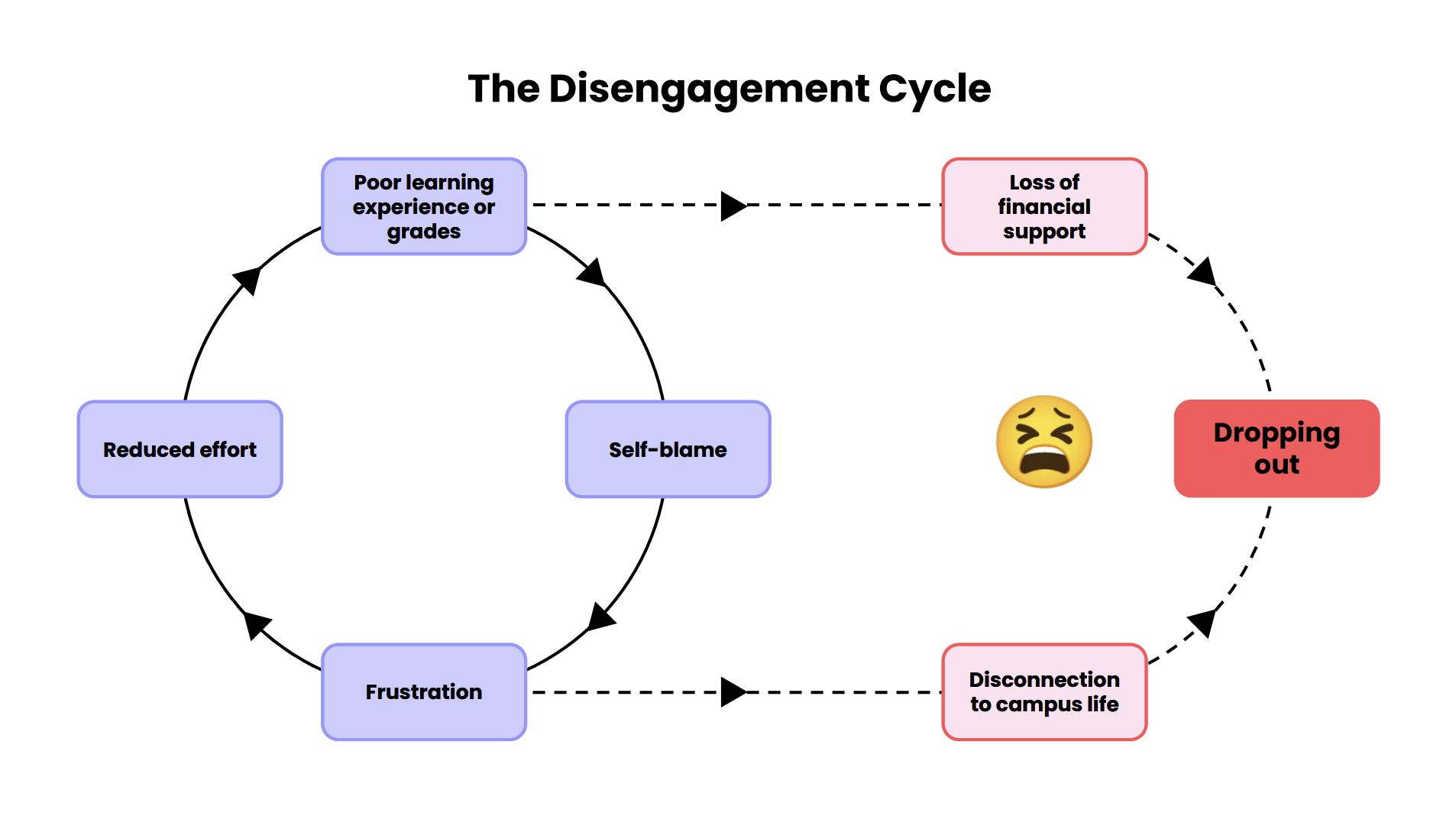
For many, a single curveball such as a car repair or a childcare lapse can trigger a disengagement cycle that leads to dropping out.
Success requires identifying the disengagement cycle before it starts. High cognitive load leads to shallow learning, which lowers grades, destroys confidence, and eventually leads to dropout.
"Sometimes life comes along and throws them a curveball. They think there's no support for that and they just have to drop out. Catching those students early when we notice they're struggling and showing that we care, that sense of belonging is really important." - Michelle Shaw
Read more about the three core challenges faced by New Majority Learners by clicking here.
How has student engagement evolved in the digital era?
Engagement today is no longer tied to physical presence or scheduled activities.
Students operate in a digital-first environment where interactions are continuous and expectations are shaped by immediacy and personalization. However, increased connectivity does not automatically lead to meaningful engagement.
Instead, engagement is increasingly defined by a connection to learning and its relevance, relationships with peers and faculty and a clear sense of purpose and future direction
This shift also challenges colleges to rethink how engagement is measured. Traditional indicators such as attendance or event participation are no longer sufficient to capture the full picture.
"Engagement really is no longer bound by time, place, or even a single modality anymore. It’s continuous, digital, and expectation-driven. If students don't see the 'why' behind their experience, engagement becomes transactional." - Tammy Wyatt
How can colleges provide proactive rather than reactive guidance?
Retention and completion rates remain important, but they are limited in scope. They do not fully capture whether students are having a positive, enriching experience, nor do they reflect the complexity of modern student journeys.
Reactive support relies on students recognizing their own challenges and seeking help. For many learners, this does not happen until issues have escalated significantly. By that point, recovery becomes more difficult and disengagement more likely.
Proactive support addresses this gap by identifying risks early and intervening before problems deepen.
At the University of Texas at San Antonio and Florida Atlantic University, ‘student thriving’ is the goal. This involves:
- Early intervention: Calling students who haven't logged into the Learning Management System (LMS) by week three.
- Belonging as a metric: Ensuring students feel they matter to the institution through personal outreach from specialized offices.
- Career integration: Connecting coursework to future employment immediately so students see the why behind their effort.
"Poor learning experiences and low grades affect a learner’s self-confidence and mental health. This heightens frustrations, which in turn lowers their motivation and often leads to reduced effort. After a few spins on the disengagement cycle, the learner can find themselves considering dropping out." - Dave Tucker
Can technology improve study skills and student confidence?
When designed with learning science at the core, digital tools serve as equalizers that provide students with independence. Many students in the New Majority are time and attention poor, making traditional study methods difficult to maintain.
Tools that support organization, note taking, and content accessibility can reduce cognitive load and help students engage more effectively with their studies. For many learners, particularly those with additional needs, tools like Genio Notes help students move from being passive consumers of information to active creators. However, the rapid adoption of AI introduces complexity.
While AI can personalize learning and provide immediate feedback, it can also be used to bypass critical thinking and deeper learning processes. The challenge lies in ensuring that technology supports skill development rather than replacing it.
"Technology empowers. It's a tool that can unblock a fundamental challenge, turning a 'D' student into an 'A' student simply by providing the right scaffold for their learning style." - Dave Tucker
To read more about how technology can be used as a tool for productive friction in learning, click here.
How should institutions approach AI and emerging learning tools?
AI should be viewed as a learning partner rather than a shortcut to be feared.
Universities are moving from banning AI to teaching AI literacy. This includes:
- Critique exercises: Having students compare their own writing to AI-generated text to spot hallucinations and flaws.
- Universal Design for Learning (UDL): Implementing tools like dictation, screen readers, and automated note taking that benefit all students, not just those with documented disabilities.
- The fast food warning: Educating students that while AI can provide quick answers, bypassing the learning process is ultimately unhealthy for long-term skill development.
Equipping students with a problem-solving framework helps them navigate the complexities of college life.
Download our free AI policy template to provide clear guidance for AI usage in your campus.
How can institutions use data to better support students?
Data is a powerful enabler of proactive support, but only when it is used effectively.
Many colleges collect large volumes of data without fully leveraging it. Fragmented systems and siloed information can limit the ability to act in a timely and coordinated way.
To make data meaningful, colleges should focus on integration and action.
"We want to get students connected to the resources that are going to help them be successful. Where we are continually looking to improve is having more of those students take advantage of the resources that we are connecting them to." - Glenn Davis
Panelists emphasized that for data to be actionable, systems must speak to one another (API-first approach). Instead of looking at lagging indicators like final grades, schools look at leading indicators such as LMS engagement, midterm progress and digital footprint.
The goal is not simply to gather data, but to translate it into timely, personalized support.
Higher education is moving toward a more learner-centred model. This shift requires colleges to design systems that are flexible, inclusive, and responsive to diverse needs. It also demands a cultural change, one that prioritizes connection, belonging, and continuous support.
By investing in proactive systems, integrating technology with purpose, and embedding inclusivity at every level, colleges can create environments where all students have the opportunity not just to succeed, but to thrive.
Want to learn more about the New Majority Learners in your campus?
Click below to get a full breakdown of your institution's data, and how it compares to your state and the whole country.
Share this blog





Time for a simpler, smarter note taking accommodation?