


















Key takeaways:
- 85% of struggling students won't seek help: Traditional student support systems assume students will self-advocate, but the vast majority of learners facing academic challenges never raise their hand.
- Dropout is a visibility challenge: 45% of first and second-year dropouts come down to how students feel about their academic performance which isn’t tied to their grades alone.
- New Majority Learners are the most affected: Working students, student parents, first-generation students, and students with disabilities all face significantly higher persistence risks and are the least likely to ask for help.
- A single touchpoint changes outcomes: Students with one advising touchpoint persist at an 18% higher rate.
- Genio Notes acts as an invisible entry point: With Just-In-Time provisioning through an LMS integration, institutions can reach students using Genio Notes long before they enter formal support systems.
In higher education, some of the biggest persistence risks don't show up in the data until it's too late. Students who are attending classes, meeting deadlines, and carrying a decent GPA can still be drowning, but most of them will never ask for help.
This is how the disengagement cycle takes hold. Unsupported challenges spiral into frustration and diminished confidence, with lasting effects on the students themselves and on the institutions supporting them.
In our recent Genio webinar, we walked through the research on non help seeking students, what their challenges are and how the right evidence-backed technology like Genio Notes can help colleges reach them without asking them to raise their hand.
Why don't students ask for help when they're struggling?
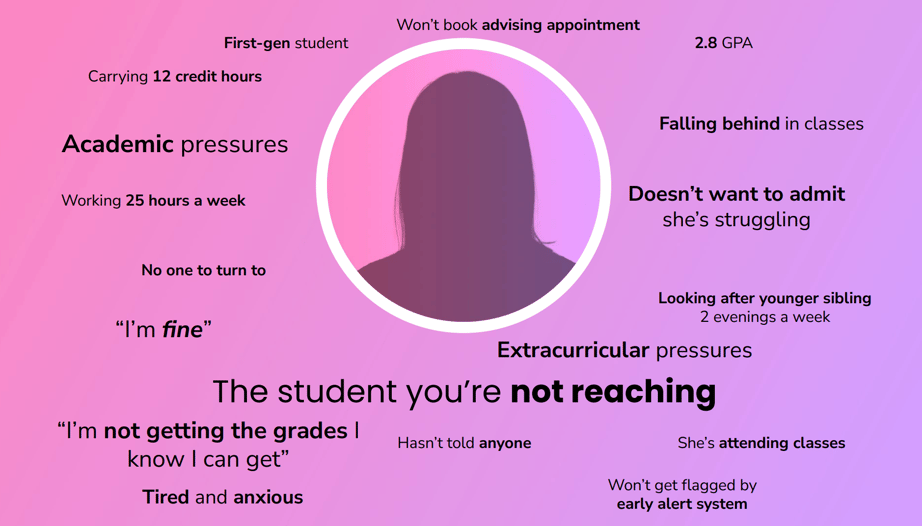
Research shows that 85% of students experiencing academic challenges will not seek help. That figure changes how institutions need to think about student support.
When an institution designs support systems that assume students will self-identify and reach out when they need help, they are effectively designing for the 15% who already know how to advocate for themselves.
At the same time, 45% of dropouts in the first two years of college are tied not to academic performance itself, but to what students learn about that performance.
21% of students with a GPA between 2.5 and 3.0 leave higher education, which means the challenge isn't academic ability, it is everything else on the learner’s plate like the job, the caregiving responsibilities, the rent and the shame spiral when a grade dips.
Dropout, in other words, is a visibility challenge as much as it is an academic one.
To learn more about how student attrition is impacting higher education's bottom line, download Genio’s Cost of Student Dropout Report.
Which students are most likely to show non-help-seeking behavior in higher education?
New Majority Learners, sometimes known as ANDers encompassing first-generation, low-income, mature, part-time, and working students, now comprise the majority of the student population across higher education.
For this student population, a passing grade is necessary, but ultimately insufficient for persistence. Instead, their survival depends upon them not only succeeding academically, but also navigating a complex mix of personal challenges that sit entirely outside the classroom.
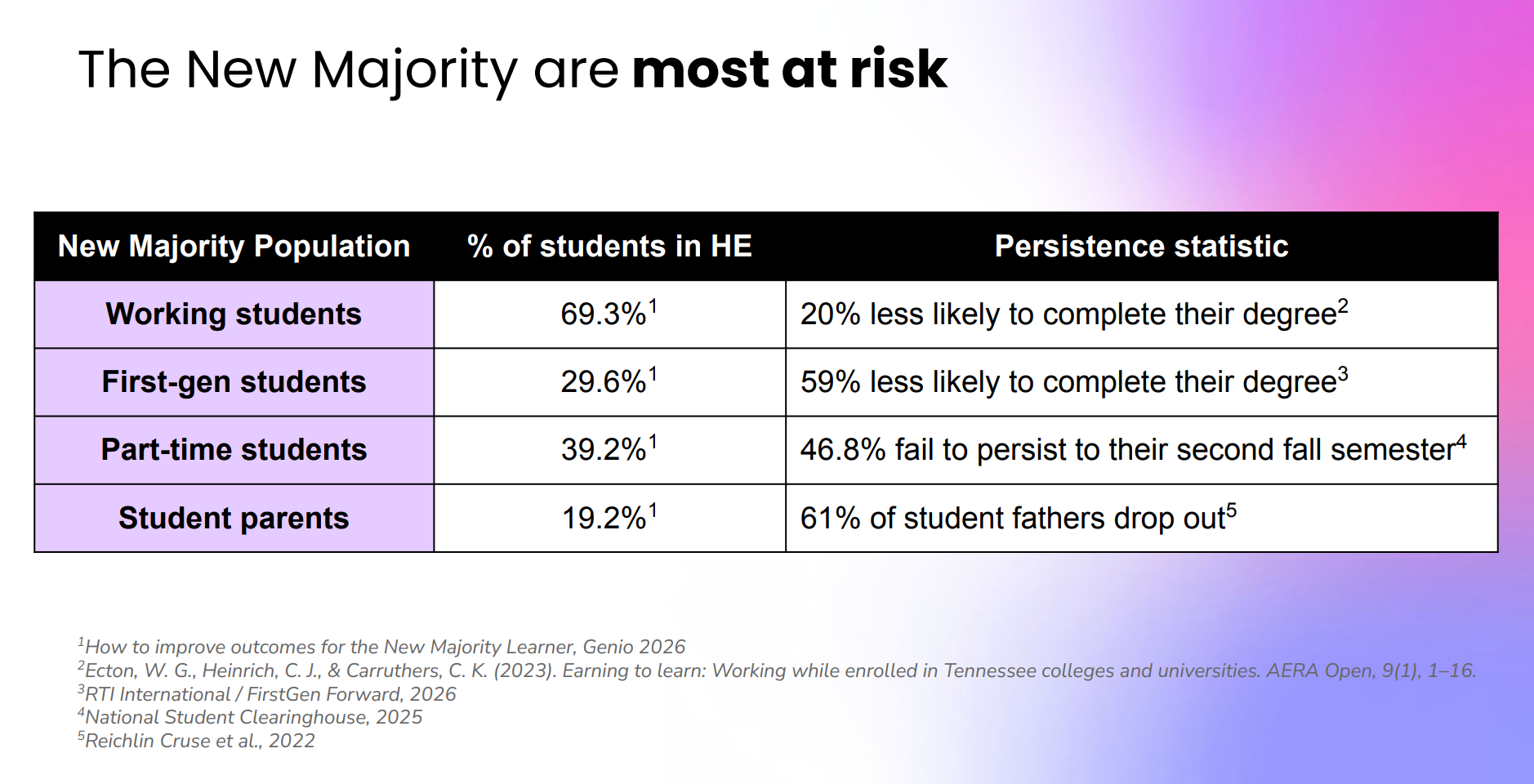
- 69.3% of undergraduates work while studying: They are 20% less likely to complete their degree than non-working peers.
- 29.6% of students are first-generation: They are 59% less likely to complete than their peers.
- 39.2% of undergraduates study part-time: 46.8% fail to persist into their second fall semester.
- 19.2% of students are parents: 61% of student fathers leave higher education without a degree.
Read more about why New Majority Learners disproportionately drop out of college.
What are the three core challenges of students who won't ask for help?
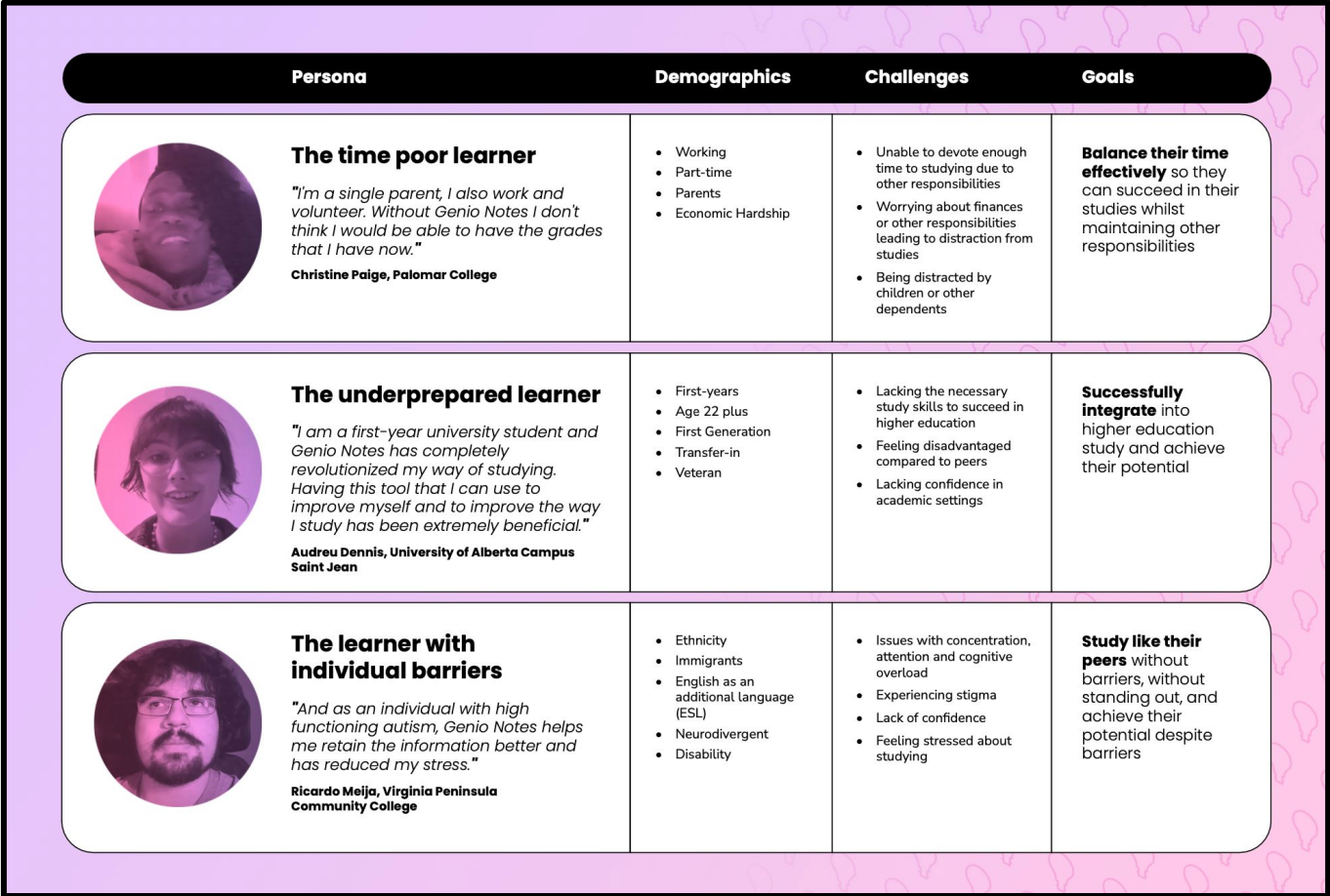
Non-help-seeking students tend to fall into three overlapping groups:
- The time-poor learner: Students juggling multiple responsibilities alongside their studies. Working professionals, parents, caregivers, apprentices, and student athletes all sit within this group, with time poverty as the defining characteristic. For these learners, the barrier is purely logistical.
- The underprepared learner: Students who may lack the foundational skills or knowledge needed for academic success. First-generation students, first-year students, veterans, and international students often fall into this category. Many don't know what to ask for, or that asking is an option.
- The learner with barriers: Students with disabilities, mental health challenges, and language barriers. Around 65% of students who had accommodations in K-12 don't disclose their disability in higher education, often because of stigma and the fear that comes with naming a struggle out loud.
All three groups face the same structural barrier. Traditional support systems require them to self-identify and take the first step, and most won't.
Read more about the three core challenges of the New Majority Learner
Why do proactive advising and early alerts fall short for non-help-seeking students?
Proactive advising and early alert systems are the two most common approaches institutions use to identify students before they slip. Both do valuable work, but they also share a structural limit that can’t clearly identify non-help-seeking students at the first point of disengagement.
Proactive outreach depends on the student to respond. An email, a call, or an appointment offer only works when the student is ready to engage with it. When they don't answer or can't make the time work, no connection happens and over time, that gap can lead to dropout.
Early alert systems catch students who are already visibly struggling. This is important work, and it's why institutions invest heavily in these systems.
But early alerts fire after something has already triggered them and for the 85% who never raise their hand, that trigger may not come until it is far too late to intervene.
How does Genio Notes reach non-help-seeking students at scale?
The best-supported students tend to be at institutions that layer multiple strategies together.
Early alert systems for visibility, supplemental instruction and embedded tutoring for group-level support, belonging initiatives like First Year Experience, peer mentoring, and learning communities to build the social trust that makes asking for help feel less risky.
But these still put the impetus on the student. A valuable option is having tools embedded in the learning environment students already navigate every day, that they can access without booking anything, asking anyone, or disclosing anything.
That is the model that Genio Notes is built around.
Every student on campus can access Genio Notes through their LMS with a single click, using their existing university credentials if they have an institution-wide Genio Notes license. There is no separate sign-up process, accommodation request or visit to an office required.
Students with a single advising touchpoint persist at an 18% higher rate. Genio Notes acts as that first touchpoint. Once a student has taken one low-stakes step and seen the value, they are far more likely to reach out for the deeper support your team offers.
Higher education is under more pressure than ever to improve retention, close attainment gaps, and support learners who don't fit the traditional model. Institutions that can reach the 85% who won't ask for help, without adding hours of manual outreach or waiting for early alerts to fire, will pull ahead.
The invisible-friction model works because it stops requiring the student to ask for support. Instead, it designs the learning space for the students who currently sit in the margins.
Want to see how Genio Notes could help you reach non-help-seeking students at your institution?
Share this blog





Time for a simpler, smarter note taking accommodation?